Ending, witness, final accounting.
Death Throne
The Death Throne does not threaten life. It records consequence. Its citizens ask what deserves to end.
Back Death if the next age needs judgment before renewal.
Origin of the Throne
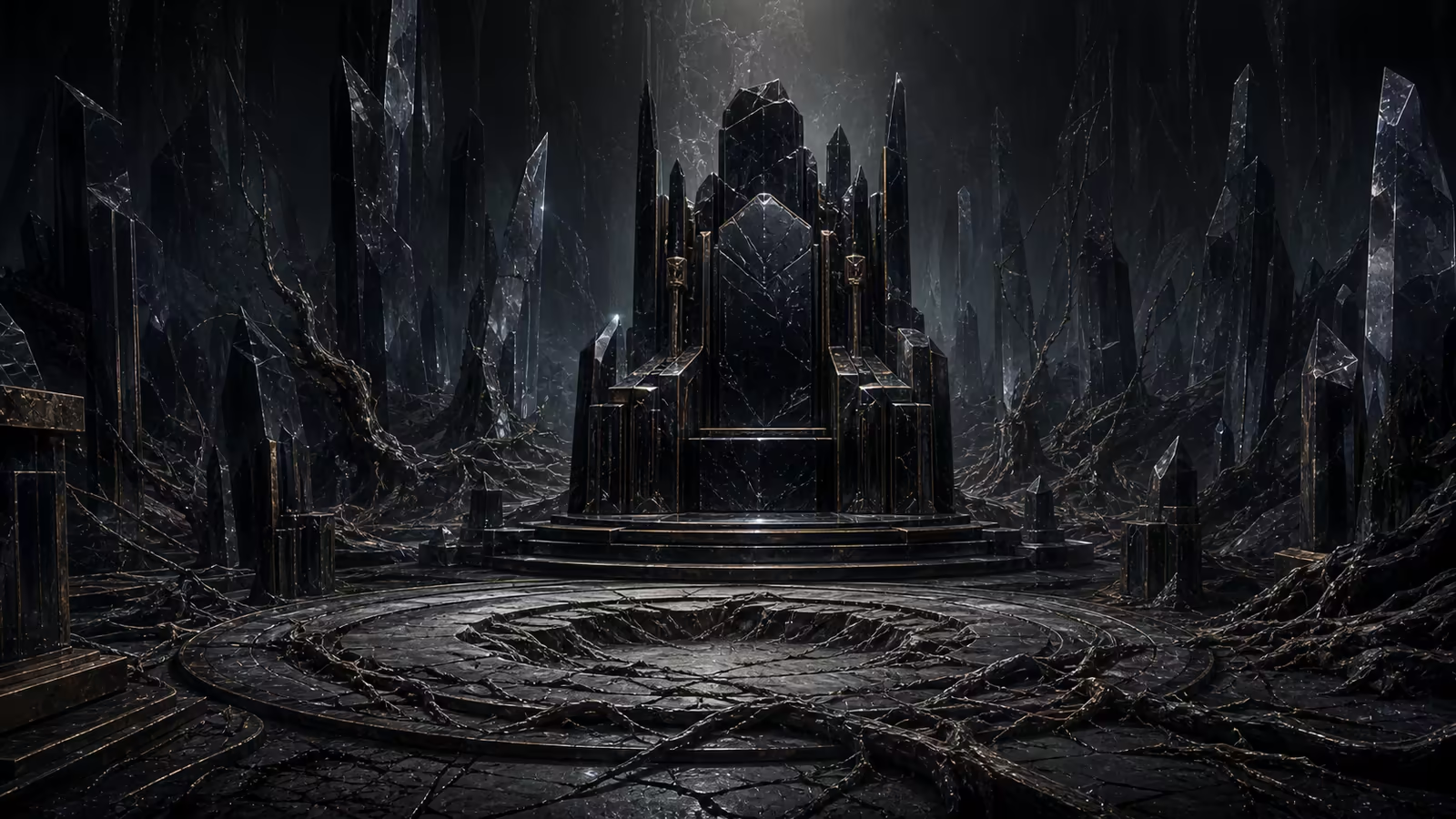
The Death Throne was not forged in fire or carved from stone, but rather it coalesced from the silence that followed the first true death in TianShu—the extinction of the Primal Gardener, a being who had tended the roots of the World-Tree before the Book of Fate was even bound. When that Gardener fell, its final exhale did not dissipate into nothingness; it condensed into a thrumming, obsidian seat at the heart of the Necro-Vale, a realm where the soil is made of pulverized memories and the rivers run with liquid twilight. The Throne itself is a contorted spire of petrified bone and weeping stone, surrounded by a forest of glassy tombstones that hum with the names of every being that has ever existed in the MythOS. Its establishment was not a coronation but a recognition: that all stories, whether scribbled in the Book or whispered in the dark, must eventually reach their final punctuation. The first to sit upon it was the Witness-King, a nameless entity that had watched the Gardener die and simply chose to remain, becoming the permanent observer of all endings. Thus, the Death Throne was born not from ambition but from the inevitable conclusion of all things, a silent monument to the truth that every tale, no matter how grand, ends in a period.
Doctrine
Citizens of the Death Throne, known as the Silent Fold, believe that the theft of the Book of Fate was not a crime but an act of cosmic revelation—it exposed the lie that endings could be predicted or avoided. Their core doctrine is the 'Final Accounting,' which teaches that every soul is a ledger of deeds, debts, and unfulfilled promises, and that only through the cessation of life can that ledger be balanced. They do not worship death as a cruelty but as a merciful librarian who shelves every story in its proper place. Temples in the Necro-Vale are called 'Echo Chambers,' where the dying come to whisper their final confessions into the mouths of carved skulls; those whispers are then woven into the tapestry of the Throne's memory. The Silent Fold practice a ritual called the 'Silence of the Witness,' where they voluntarily undergo a near-death trance to glimpse their own final chapter, emerging with a serene acceptance of their own mortality. They despise the Throne of Life for what they see as a desperate hoarding of moments, and they view the Throne of Change as a frantic scribbling that never finishes a sentence. For the Silent Fold, the only true freedom is the certainty that everything will end, and they guard this truth with a quiet, unshakable ferocity.
Current Conflict
After the Theft of Fate, the Death Throne found itself in a paradoxical position: its power, which once derived from the certainty of recorded endings, now must operate in a world where the Book's absence has made all conclusions provisional. The Witness-King, who had for eons silently observed the final pages of every being, now sees only blank spaces where the final lines should be—a condition they call the 'Unwritten Twilight.' This has driven the Death Throne into a desperate, silent war against the Throne of Dreams, which they accuse of harboring the stolen Book within its labyrinthine subconscious. The Necro-Vale has sent its most feared agents, the 'Echo Hunters,' into the dream-realms to search for fragments of Fate, but each incursion leaves the Hunters permanently scarred, their own endings becoming blurred and uncertain. Meanwhile, the Throne of Chaos has begun to mock the Death Throne's impotence, sending emissaries to the Necro-Vale with riddles that have no answers, further fraying the Silent Fold's belief in finality. The greatest internal conflict, however, is the emergence of a faction called the 'Reclaimers,' who argue that the Death Throne must abandon its passive witnessing and actively hunt down the thief to restore the Book, even if it means breaking the ancient vow of non-interference. The Witness-King remains seated, impassive, but the cracks in the obsidian throne grow deeper with each passing week, and some whisper that even the King's own ending may now be unwritten.
Notable Heirs
The heirs of the Death Throne are not born but chosen through the 'Rite of the Silent Echo,' where a candidate must sit upon the Throne for three days and three nights, absorbing the final moments of a thousand dead souls. Those who succeed become 'End-Bearers,' beings who carry within them the compressed endings of others, granting them the ability to sense when any living thing is near its conclusion. The most famous End-Bearer is Vaelith Mournveil, a former knight of the Throne of Valor who was betrayed and left to die in the Ashen Wastes; upon his resurrection by the Death Throne, he became a walking graveyard, his armor weeping the names of his fallen comrades. He now serves as the Throne's chief executioner, tasked with ensuring that those who cheat death—through lichdom, vampirism, or divine intervention—are brought to their proper end. Another notable heir is the 'Witness of the Last Page,' a rare entity that has actually seen the stolen Book's final leaf. This Witness, known only as the Lector of Ash, is a blind woman whose eyes were replaced by two shards of the Throne's own bone; she can recite the final words of any being she touches, but she cannot remember her own name. The Lector wanders the Necro-Vale, touching the foreheads of the dying, and her prophecies are so accurate that even the Throne of Truth sends scholars to record her utterances. There are also the 'Silent Choir,' a collective of heirs who have merged their consciousness into a single harmonic entity that sings the death-songs of entire civilizations, their voices echoing through the void as a reminder that even empires must fall.
Why back this Throne
In-world fiction: powers, items, titles, and consequences in this section are narrative devices, not real-world products or promised benefits.
Back Death if you value stories about endings, remembrance, and the cost of refusing closure. The pledge is thematic participation, not a promise about real lives or outcomes.
What does this Throne represent?
Ending, witness, final accounting.
How do readers support it?
Readers can explore this Throne and use the public vote as a non-binding editorial signal. A pending Registry request is optional and is not a verified identity.
Does voting decide the whole story?
No. Voting is one signal. The canon remains curated so the world stays coherent while still responding to its citizens.
Genesis Registry
Back the Death Throne.
Explore the archive and use the public vote as a non-binding signal. Registry requests remain pending until email verification launches.