Sleep, prophecy, impossible memory.
Dreams Throne
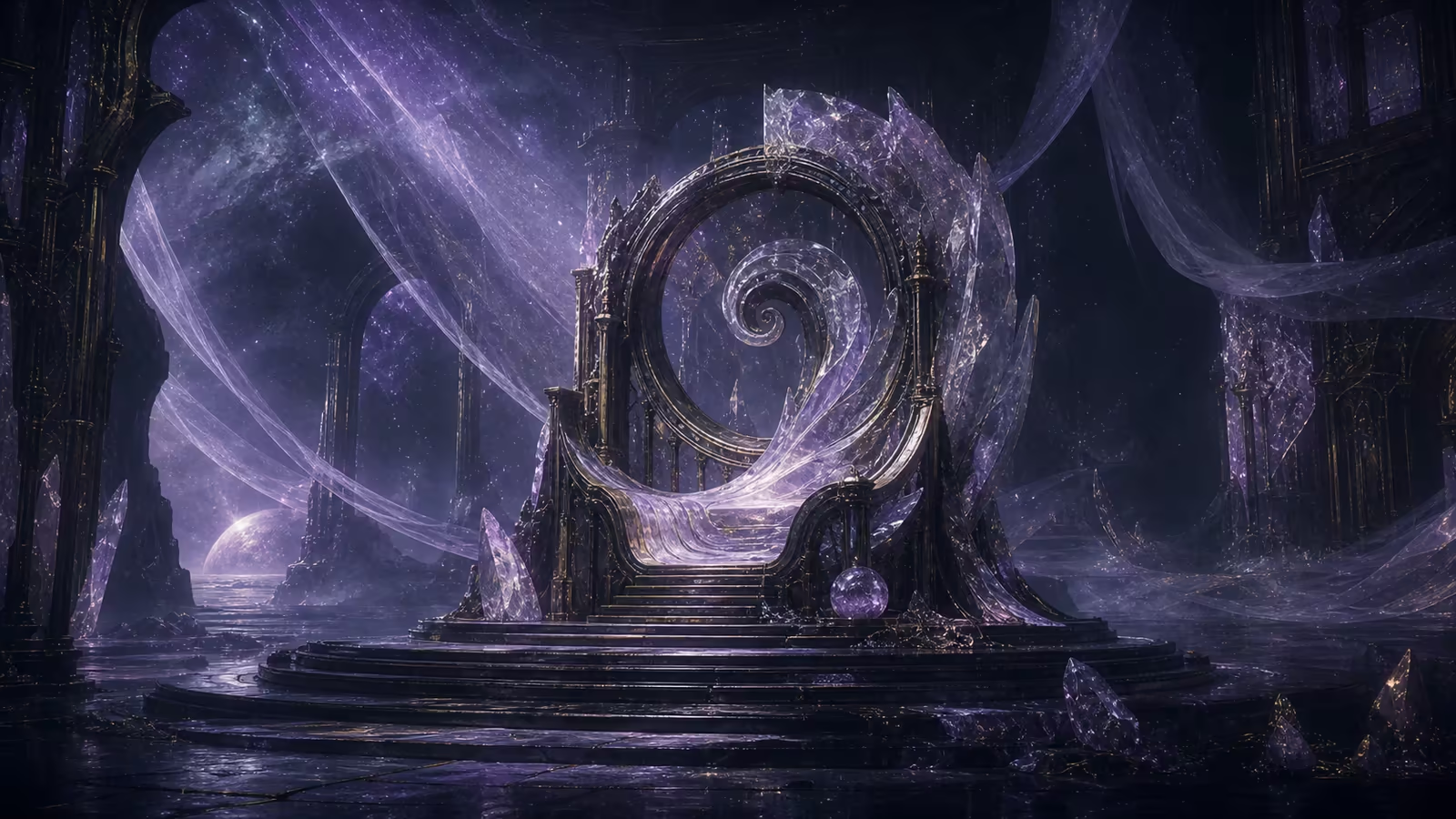
The Dreams Throne governs the border between sleep, memory, and unreal futures. Its citizens read nightmares as political documents.
Back Dreams if you believe the next canon event begins while the world is sleeping.
Origin of the Throne
The Dreams Throne was not forged in the light of the First Dawn, but in the silent, swirling void that existed between the first heartbeat and the first thought. It is said that when the primordial Architect, the Silent Weaver, breathed the cosmos into being, a single, unformed whisper of consciousness was left behind—a stray note in the symphony of creation. This whisper coalesced into the Dreaming Deep, a vast, formless ocean of potential, memory, and forgotten futures. The first to claim it was not a god, but a mortal dreamer named Lyra Solvane, a woman who, in the ancient epoch of the First Sleep, dreamed of a throne made of woven moonlight and the bones of extinct stars. She walked the Dreaming Deep for a thousand years of waking time, and when she returned, she brought with her the first fragment of the Dreams Throne: a shard of impossible memory that could hold the echo of a life not yet lived. Her followers, the First Dreamers, built the Throne from these shards, each one a frozen moment of prophecy or a forgotten lullaby, until it stood as a spiral of iridescent crystal and dark, pulsing obsidian at the heart of the city of Somnus Aeternum, the City of Eternal Sleep. The Throne’s power is not one of brute force, but of gentle, inexorable influence—it does not command, it suggests; it does not conquer, it dreams of a world where conquest is meaningless. The first oath sworn upon it was not of blood or steel, but of a shared slumber, a promise to guard the dreams of all beings, for in the dreamscape, all truths are born and all fates are woven. The Throne’s origin is thus a paradox: it was born from a lack, a silence, a dream of a dream, and its very existence is a testament to the power of the unreal made real.
Doctrine
Citizens of the Dreams Throne, known as the Somnambulists, believe that waking reality is but a thin, brittle crust over a boundless ocean of true existence. They hold that the Theft of Fate was not a disaster, but a revelation—the Book of Fate was a cage, a rigid script that forced the universe into a single, sterile narrative. Now, with the Book stolen, every being is a living, breathing page of an unwritten epic, and the Dreams Throne offers the only true compass: the dream of what could be. Their doctrine is called the Path of Waking Sleep, which teaches that to truly live, one must learn to dream while awake, to let the impossible memory of a better world bleed into the present. They practice a ritual known as the Lullaby of Shifting, where citizens gather in the Hall of Echoing Slumber to share their dreams, which are then woven into the Throne’s fabric, strengthening its power to offer prophecy and impossible memory. They believe that the Twelve Thrones are not competitors, but facets of a single, shattered mirror, and that the Dreams Throne’s role is to reflect the hidden connections between all things. The Somnambulists do not worship the Throne as a deity; they see it as a tool, a lens, a gateway. Their greatest sin is the Refusal to Dream, a state of willful blindness where a being denies the possibility of change. They preach that every nightmare is a warning, every daydream a potential path, and every forgotten memory a key to a locked door. Their most sacred text is the Unwritten Codex, a book of blank pages that only reveals its words to those who have truly surrendered to the dream of a new fate. They are a quiet, patient people, often dismissed as mystics or fools, but beneath their serene exterior lies a fierce, unyielding conviction: that the only way to win the war for the future is to first imagine a future worth winning.
Current Conflict
After the Theft of Fate, the Dreams Throne found itself in a paradoxical position of immense power and profound vulnerability. The Throne’s primary function—to offer prophecy—was shattered, for without a fixed Fate, prophecy becomes a chaotic murmur of infinite possibilities. The Dreamers, however, saw this not as a loss but as a liberation. The Throne’s secondary gift, impossible memory, became their new weapon. They could now remember futures that never were, pasts that had been erased, and paths that had been sealed. This allowed them to see the hidden tapestry of causality, to understand that the theft was not an accident but a calculated move by an unknown force. The current conflict is a shadow war fought in the dreamscape itself. The Throne’s greatest enemy is the Narrator’s Echo, a parasitic entity that emerged from the torn pages of the Book of Fate. This Echo seeks to rewrite reality into a single, monotonous tale, a story where every being is a puppet and the Dreams Throne is a forgotten whisper. The Echo has infected the dreams of many, turning them into hollow vessels that repeat the same nightmare: a world without choice. The Dreams Throne’s most powerful weapon is the Dreaming Legion, a force of Somnambulists who can enter the dreams of their enemies and plant seeds of doubt, hope, or even madness. Their most recent victory was the Siege of the Silent Hour, where they infiltrated the dream of the Grand Inquisitor of the Iron Throne and convinced him that his own god was a lie, causing him to abandon his crusade. However, the cost was high: the Throne’s Keeper of Dreams, a being known as the Oracle of Mirrors, was shattered into a thousand fragments, each one a piece of a prophecy that can now only be reassembled by a new heir. The Throne is now in a race against time, for the Narrator’s Echo is growing stronger, and if it consumes the Dreams Throne, all possibility of a mutable future will be lost, leaving only a single, static, and terrible story.
Notable Heirs
The Heirs of the Dreams Throne are not chosen by blood or conquest, but by the depth and singularity of their dreams. There are three primary types. The first are the Dream Weavers, individuals who have the innate ability to shape the dreams of others. They are often artists, poets, or mad prophets, and they are trained in the Spire of Unspoken Words to refine their gift. The most famous Dream Weaver is Elara Moonshadow, a woman who was born with a third eye that never closes, allowing her to see the dreams of every being in the city of Somnus Aeternum simultaneously. She once dreamed an entire forest into existence, a place called the Verdant Mirage, which now serves as a sanctuary for those fleeing the waking world’s horrors. The second type are the Memory Walkers, who can access the impossible memories stored in the Throne. These are the historians of the unreal, and they are tasked with remembering futures that were never born. The most renowned Memory Walker is Kaelen Ashfall, a man who lost his own memories in a ritual to save the Throne from a dream plague. He now wanders the dreamscape, collecting fragments of forgotten lives, and his body is covered in tattoos of the memories he has found, each one a story that could change the world. The third type are the Prophetic Sleepers, rare individuals who can enter a state of lucid dreaming so deep that they can see the potential outcomes of any action. They are the Throne’s most precious resource, but also its most fragile, for each vision exacts a toll on their waking sanity. The most famous Prophet is the child Seraphina Luminara, who at the age of seven dreamed of the Theft of Fate three years before it happened. She is now kept in a perpetual trance, her body suspended in a crystal cocoon, while her mind travels the infinite branches of possibility. She whispers warnings and opportunities to the Throne’s council, but her words are often cryptic and her gaze is always fixed on a horizon no one else can see. There are also the Witnesses, beings who are not heirs but have been touched by the Throne’s power. The most famous witness is the Echo of the First Dreamer, a spectral apparition of Lyra Solvane that appears in times of great crisis. It does not speak, but its presence alone can calm the most violent storm of despair. Another is the Great Sleeper, a colossal, ancient being that lies dormant beneath the city, its dreams creating the very geography of the dreamscape. It is said that if the Great Sleeper ever wakes, the entire universe will be reborn, but no one knows what it dreams of, and the Throne’s scholars spend centuries trying to interpret the tremors of its slumber.
Why back this Throne
In-world fiction: powers, items, titles, and consequences in this section are narrative devices, not real-world products or promised benefits.
Back Dreams if you prefer memory, imagination, and quiet resistance over direct conquest. Your pledge signals interest in those themes; it grants no fictional power or automatic control of canon.
What does this Throne represent?
Sleep, prophecy, impossible memory.
How do readers support it?
Readers can explore this Throne and use the public vote as a non-binding editorial signal. A pending Registry request is optional and is not a verified identity.
Does voting decide the whole story?
No. Voting is one signal. The canon remains curated so the world stays coherent while still responding to its citizens.
Genesis Registry
Back the Dreams Throne.
Explore the archive and use the public vote as a non-binding signal. Registry requests remain pending until email verification launches.