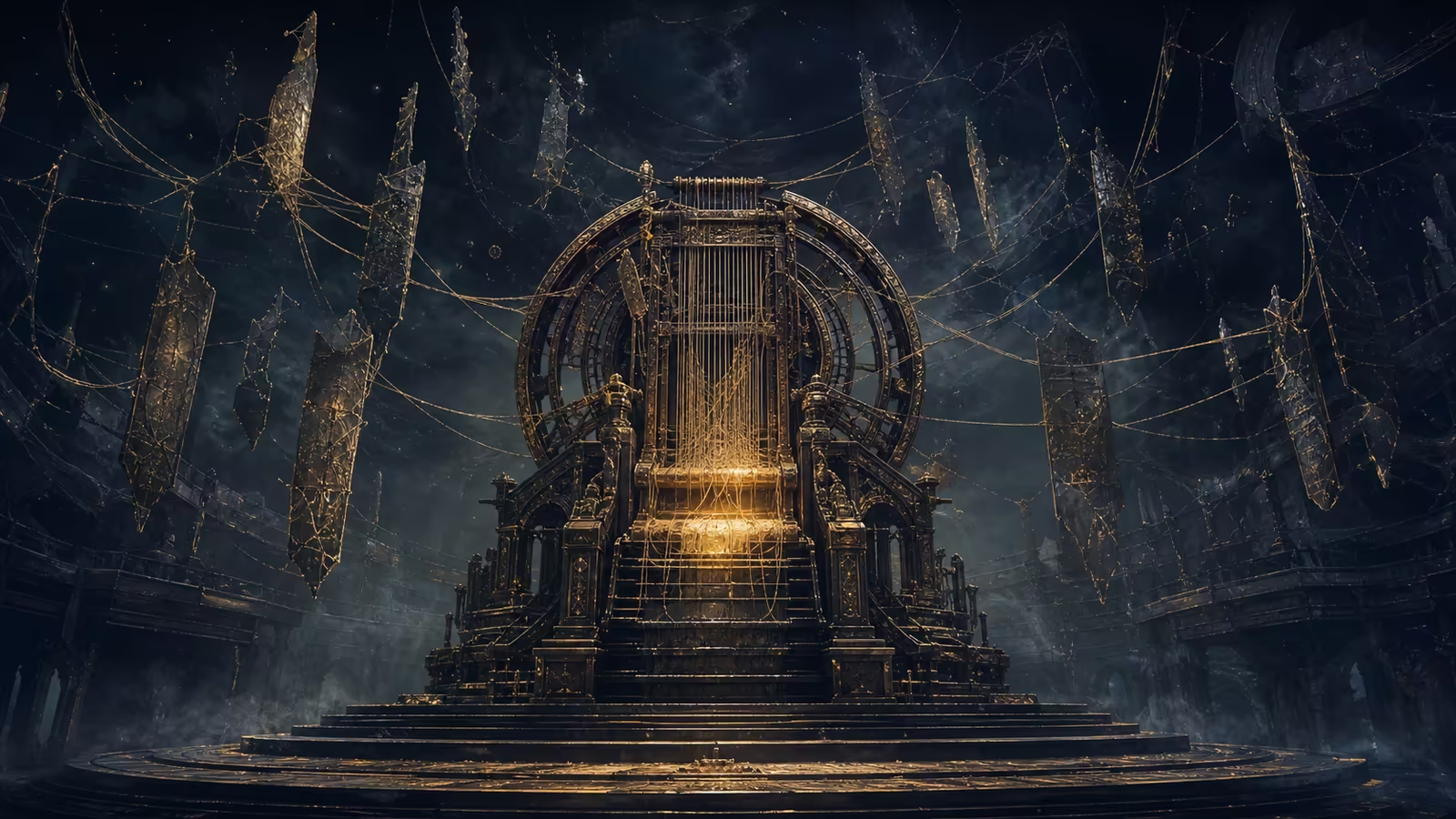
Pattern, causality, broken prophecy.
Fate Throne
The Fate Throne preserves the memory of futures that no longer exist. Its citizens hunt the missing Book and treat coincidence as evidence.
Back Fate if you believe the stolen pattern can still be reconstructed.
Origin of the Throne
The Fate Throne was established in the aftermath of the First Sundering, when the cosmic loom of the Book of Fate was still intact but already fraying. In those days, the realm of TianShu was a tapestry of deterministic threads, every action and outcome woven by the Great Weavers, beings of pure causality who resided in the Spire of Unyielding Order. However, a schism erupted among the Weavers when a faction, led by the enigmatic Oracle-Matriarch Seraphine Vel-Korr, argued that true power lay not in following the threads but in reading the patterns that emerged from their chaos. Seraphine, a seer with eyes that bled silver light, claimed to have glimpsed a future where the Book itself would be stolen, and that only by embracing the fractures in causality could any throne survive. She gathered a coterie of pattern-breakers, paradox scholars, and exiled prophets, and they fled the Spire to settle in the shattered remains of the Celestial Caldera, a volcanic basin where the fabric of reality was thin and prone to warping. There, using shards of the original Loom that had been shattered in the Sundering, they forged the Fate Throne—a seat carved from obsidian and crystallized prophecy, its surface etched with shifting runes that never held the same meaning twice. The Throne’s establishment was sealed when Seraphine performed the Ritual of the Broken Thread, deliberately severing her own fate-line from the universal weave, an act that caused a ripple of paradox across all of TianShu, marking the Throne as a sanctuary for those who rejected absolute determinism. From that moment, the Fate Throne became a beacon for individuals who believed that destiny was a language to be interpreted, not a law to be obeyed, and its foundation was a declaration that even in a universe of cause and effect, chaos could birth new order. The Caldera itself became a living forge, where the heat of the planet’s core mixed with the ambient psychic residue of broken prophecies, creating a landscape of constantly shifting geography—mountains that grew and shrank with the phases of the moon, rivers that flowed backward during eclipses, and forests where trees bore fruits that tasted of forgotten memories. The Throne’s first citizens built their city, Aethel-Korr, directly into the Caldera’s walls, using the natural instability as a defense against the more rigid thrones that sought to destroy them. They called themselves the Fractured, and their society was built around the belief that the only constant was change, and that the most profound truths emerged from the spaces between what was meant to be and what actually occurred.
Doctrine
The citizens of the Fate Throne, known as the Pattern-Scribes, adhere to a philosophy called the Doctrine of the Unraveled Thread. They believe that the Book of Fate was never a fixed text but a living narrative that required constant reinterpretation, and that its theft was not a catastrophe but a liberation—a chance for all beings to rewrite their own destinies without the tyranny of a predetermined script. The core tenet is that causality is not a chain but a web, and that every action creates multiple potential futures, each as valid as the last. They reject the concept of 'destiny' as a linear path, instead embracing 'pattern-walking,' the art of navigating through the overlapping probabilities of existence. Their temples, called Echo-Chambers, are built in zones of high temporal flux, where worshippers meditate on the echoes of actions not taken, seeking guidance from the ghosts of choices that never materialized. The central liturgy is the Rite of the Fractured Mirror, where each citizen must shatter a personal relic (a keepsake from their past) and then reassemble it into a new form, symbolizing the transformation of broken fate into personal agency. They venerate the 'Silent Witnesses'—moments of pure paradox where cause and effect temporarily invert, such as the annual event known as the Backward Dawn, when the sun rises in the west and sets in the east for three days. During this time, the Pattern-Scribes hold the Festival of Reversed Oaths, where they swear vows they intend to break, believing that the act of swearing a false oath creates a crack in the rigid structure of fate, allowing new possibilities to seep in. Their legal system is based not on precedent but on 'precedent-inversion,' where a ruling is made by considering the opposite of what traditional law would dictate, then adjusting for the resulting paradox. This has led to a society that appears chaotic to outsiders but operates on a deep, intuitive logic that values creativity and adaptability over rigid order. The Fate Throne’s citizens are fiercely protective of their autonomy, viewing any attempt to impose a single truth as a form of tyranny. They maintain libraries of 'unwritten books'—volumes filled with blank pages that are enchanted to reveal text only when the reader is in a state of profound uncertainty, ensuring that knowledge is earned through personal struggle. Their currency is not gold but 'probability coins,' which can be spent to temporarily alter the likelihood of an event, making the economy itself a tool for reshaping reality.
Current Conflict
After the Theft of Fate, the Fate Throne entered a period of existential crisis and opportunity. The disappearance of the Book of Fate was both a validation of their doctrine—proving that destiny was not immutable—and a profound threat, as the very patterns they studied were now orphaned, adrift without a central anchor. The Throne’s current ruler, the Oracle-King Valerius the Unbound, has declared a state of 'Creative Schism,' where all Pattern-Scribes are encouraged to interpret the void left by the Book as a blank canvas. However, this has led to factional violence between two primary sects: the Weavers of the New Tapestry, who believe that the Throne should attempt to forge a new, collective fate for all of TianShu, and the Keepers of the Fracture, who argue that any attempt to create a unified fate is a betrayal of the Throne’s core principle of chaos. The Weavers, led by the charismatic prophetess Lyra Ash-Thorn, have begun constructing a massive artifact called the Loom of Shadows, a device that can harvest the residual energy of the stolen Book from the aether, aiming to weave a new destiny that embraces paradox as its foundation. The Keepers, under the grizzled veteran Mirage Vex, have sabotaged the Loom twice, using 'paradox bombs'—devices that cause localized reality failures, creating zones where two contradictory events occur simultaneously, such as a room where it is both raining and not raining. The conflict has spilled into the Caldera’s streets, with skirmishes erupting in the Echo-Chambers and probability markets. Meanwhile, the other thrones view the Fate Throne with a mixture of suspicion and envy. The Throne of Iron Law has declared the Fate Throne a 'causal anomaly' and has sent assassins—the Logicians—to eliminate Valerius, believing that his death will stabilize the local reality. The Throne of Eternal Silence, which worships the void before creation, has offered an alliance, but only if the Fate Throne agrees to permanently destroy the Loom of Shadows, a demand that Valerius has refused. Adding to the chaos, the theft has awakened a ancient entity known as the Paradox Wyrm, a being that feeds on broken prophecies and now slumbers beneath the Caldera, its dreams causing random fluctuations in the Throne’s reality—sometimes aging citizens centuries in a day, other times reverting them to infancy. The Fate Throne’s role in the post-theft world is thus one of perpetual negotiation: they must balance their core philosophy of embracing chaos with the practical need for stability, all while fending off external threats and internal collapse. Valerius has begun secret negotiations with the Throne of Forgotten Names, hoping to acquire a fragment of the stolen Book’s index, which might reveal the true nature of the theft and whether any hidden pattern remains. The outcome of these tensions will determine whether the Fate Throne becomes the new epicenter of TianShu’s destiny or dissolves into a self-consuming paradox.
Notable Heirs
The heirs of the Fate Throne, called the Witnesses of the Unwritten, are not born but chosen through a process known as the Paradox Trial. This trial involves three stages: first, the candidate must survive a journey through the Shifting Labyrinth, a maze beneath the Caldera that rearranges itself based on the candidate’s fears and desires, forcing them to confront the patterns of their own psyche. Second, they must perform a 'causal inversion'—an act that deliberately breaks a fundamental law of their personal history, such as saving a life they had previously failed to save in a memory, or causing an event they had previously prevented. This is achieved through the use of 'echo keys,' artifacts that allow brief access to alternate timelines. Third, they must sit upon the Fate Throne itself for a full lunar cycle, during which they are bombarded with visions of every possible future that could have been, from the mundane to the catastrophic. Those who emerge intact are considered heirs, though many are driven mad, their minds shattered by the weight of infinite possibility. The most famous heir is the current Oracle-King Valerius the Unbound, who completed his trial at the age of seventeen, emerging with the ability to see not just the branches of fate but the 'knots'—points where multiple timelines converge and diverge. He is known for his 'silver gaze,' a side effect of the trial that causes his eyes to reflect the faces of people who do not yet exist. Another notable heir is the vanished prophetess Elara Wind-Singer, who during her trial, saw a vision of the Book of Fate’s theft and tried to prevent it by warning the Great Weavers. She failed, and her timeline was 'pruned,' leaving her as a ghost that only appears during the Backward Dawn, reciting fragments of prophecies that no longer apply. She is considered a martyr by the Keepers of the Fracture and a cautionary tale by the Weavers. The Throne also recognizes 'False Heirs'—individuals who have survived the Paradox Trial but rejected its implications. The most infamous is Kaelen the Still, a warrior who emerged from the trial with the power to freeze probability, making him immune to change but also incapable of growth. He now leads a cult of 'Stasis-Worshippers' who believe the Throne should seek to freeze the current state of chaos, a dangerous ideology that Valerius has outlawed. Witnesses to the Fate Throne’s power include the legendary chronicler Vexian the Unreliable, a being who records history as it should have been, not as it was, and whose scrolls are considered both sacred texts and absurdist comedies. There is also the Silent Oracle, a statue in the central plaza that occasionally weeps tears of liquid prophecy, which, when collected, can be used to temporarily alter the future of whoever drinks them. The most recent notable witness is the child prodigy Mira Star-Weaver, who at age twelve predicted the exact moment the Loom of Shadows would be sabotaged, but her prediction was so precise that it caused the sabotage to happen, creating a self-fulfilling paradox that has left her in a state of quantum superposition—she is both alive and dead, and her condition is studied by the Throne’s scientists as a potential tool for future manipulation of fate.
Why back this Throne
In-world fiction: powers, items, titles, and consequences in this section are narrative devices, not real-world products or promised benefits.
Back Fate if you enjoy stories about probability, paradox, and choices made without certainty. Your public pledge is a non-binding signal that editors may consider when reviewing future conflicts.
What does this Throne represent?
Pattern, causality, broken prophecy.
How do readers support it?
Readers can explore this Throne and use the public vote as a non-binding editorial signal. A pending Registry request is optional and is not a verified identity.
Does voting decide the whole story?
No. Voting is one signal. The canon remains curated so the world stays coherent while still responding to its citizens.
Genesis Registry
Back the Fate Throne.
Explore the archive and use the public vote as a non-binding signal. Registry requests remain pending until email verification launches.