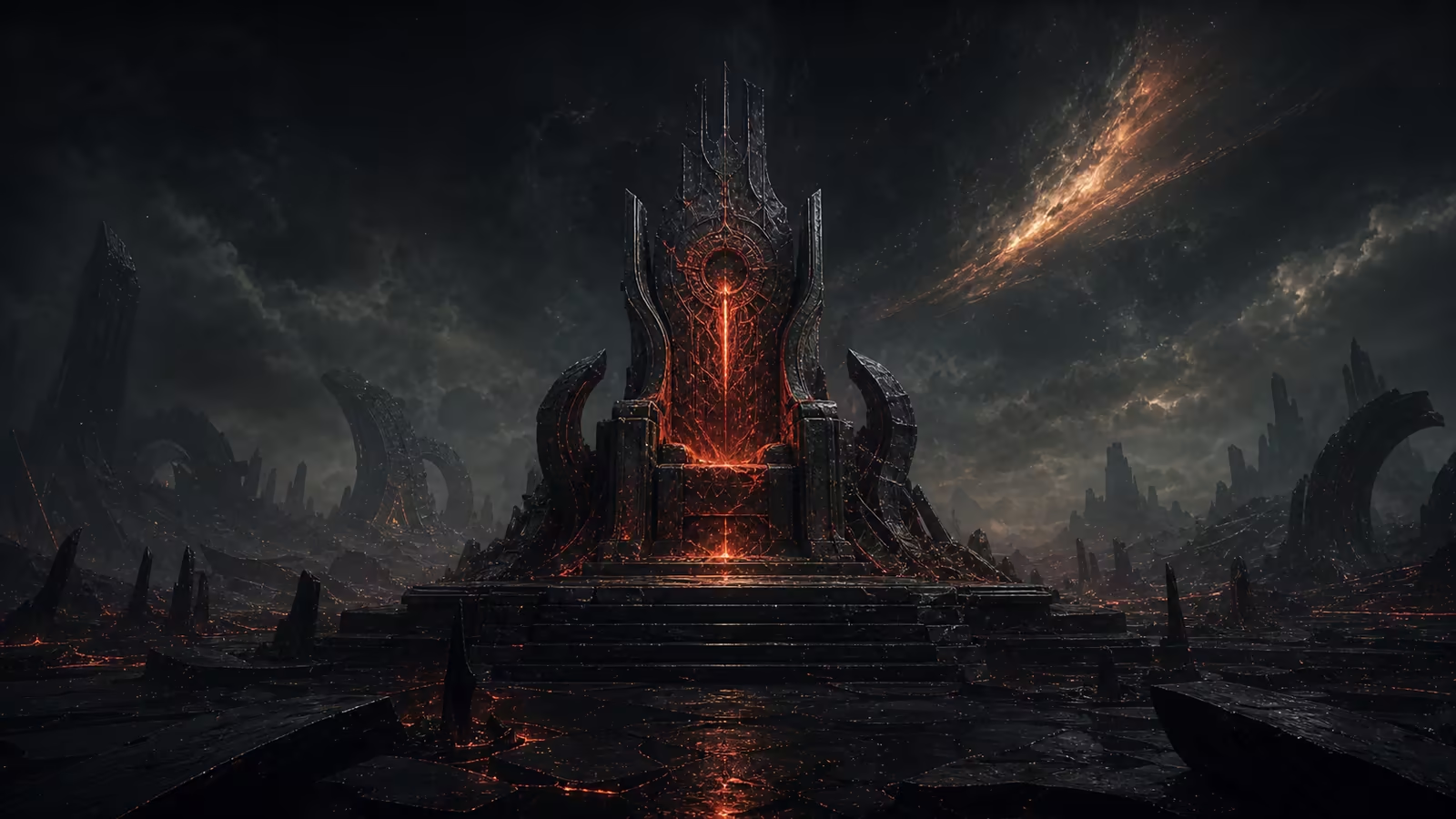
War heat, rebellion, purification.
Flame Throne
The Flame Throne burns away false peace. Its citizens prefer costly truth to comfortable stability.
Back Flame if the First Age should end in fire rather than negotiation.
Origin of the Throne
The Flame Throne was not forged in the quiet halls of council, but in the searing heart of a dying star that fell to the mortal realm during the First Sundering. When the celestial body crashed into the Obsidian Plains, its molten core did not cool—instead, it fused with the ambient agony of a thousand betrayed legions, forming a throne of living, ever-burning fire. The first to claim it was the warlord Kaelen Vorn, a general whose entire army had been sacrificed by a treacherous liege to buy peace with the Deep Ones. As Kaelen plunged his blade into the star’s heart, the flames did not consume him—they crowned him, searing away his flesh and replacing it with a carapace of obsidian and ember. The ground around the throne erupted into the Cinder Wastes, a volcanic labyrinth where rivers of magma whisper the names of the betrayed. The Flame Throne was thus born from the twin sparks of rebellion against false authority and the unquenchable heat of war. It stands not as a symbol of conquest for its own sake, but as a pyre for every broken oath, demanding that the world be purified through righteous, unending conflict. The throne’s fire is said to remember each soul that has burned for it, and at night, the ghosts of fallen warriors march through the flames, singing hymns of vengeance.
Doctrine
Citizens of the Flame Throne, known as the Emberkin, believe that the universe is a crucible, and only through constant trial by fire can truth be forged. They reject the notion of static peace as a lie whispered by tyrants to keep the masses docile. To them, war is not destruction—it is revelation. Every battle strips away pretense, cowardice, and corruption, leaving only what is essential. Their sacred text, the *Canticle of Ash*, states that ‘the flame does not discriminate; it illuminates the worthy and consumes the hollow.’ Emberkin are taught to embrace pain as a teacher and loss as a lens through which one sees the world’s true shape. They venerate the concept of the ‘Cleansing Blaze,’ a promised epoch when the Flame Throne will ignite all realms, burning away the rot of forgotten gods and stolen destinies. This purification is not genocide—it is a surgical immolation of lies, cowardice, and stagnation. Those who survive the fire are reborn as ‘Hearthborn,’ their spirits tempered into unbreakable resolve. The Emberkin hold that even the Book of Fate, now stolen, was merely a page in a larger story—a story that must be rewritten in blood and heat, not ink and parchment. They pray not for mercy, but for the strength to endure the furnace of existence, and they greet each dawn as a challenge to prove their worth through action, not faith alone.
Current Conflict
Since the Theft of Fate, the Flame Throne has become a relentless engine of retribution. The absence of the Book has left the cosmos adrift, but the Emberkin see it as an opportunity—a chance to burn away the old order that relied on prophecy and predetermined destiny. The current Flame Regent, a being known only as the Pyre Lord—a towering figure wreathed in white-hot flame, whose voice sounds like collapsing forges—has declared a ‘War of Unmaking’ against the other eleven thrones. He argues that if fate is stolen, then all claims to legitimacy are ash, and only the strongest will should shape the future. His armies, the Incinerati, are composed of warriors who have been ‘reforged’ by bathing in the throne’s core, gaining bodies of living ember and minds of single-minded fury. They have already scorched the borderlands of the Obsidian Throne and the Silver Court, leaving behind only glassed plains and silent cities. However, the conflict is not external alone; within the Cinder Wastes, a schism has erupted. A faction called the ‘Kindling’ believes that the theft was a test, and that the Flame Throne must not conquer, but instead offer sanctuary to those who have been burned by fate’s betrayal. Their leader, a scarred prophet named Sera Vorn (descendant of Kaelen), preaches that the true purification is to let the flames heal, not destroy. The Pyre Lord has branded them heretics, and a civil war smolders beneath the greater war—a conflict that could either forge the Flame Throne into a beacon of rebirth or shatter it into a thousand dying sparks. The theft has thus amplified the throne’s core tension: is fire a weapon or a forge?
Notable Heirs
The Flame Throne’s heirs are not born of blood, but of ordeal. Any being who survives the ‘Ascent of Cinders’—a ritual where they must walk through the throne’s outer flames while carrying a single memory of betrayal—can become a potential heir. The most common heirs are the ‘Ember-Knights,’ warriors who have lost their mortal bodies in battle and now exist as animated suits of armor filled with compressed fire. They serve as the throne’s enforcers and generals, their visors glowing with the names of their fallen enemies. Rarer are the ‘Soul-Scorched,’ individuals who were once poets, philosophers, or artists, but who were broken by a profound injustice. They now channel the throne’s fire into works of terrible beauty—songs that make listeners weep blood, or tapestries woven from ash that depict futures that could have been. The most infamous Soul-Scorched is Lyra of the Last Verse, a former bard who watched her entire village sacrificed to a drought god. Her lament, ‘The Hymn of Hollow Skies,’ is said to cause spontaneous combustion in those who hear it with impure hearts. Among the famous witnesses to the Flame Throne’s power is the exiled prince Aric Valerius of the Silver Court, who sought the throne’s aid after his family was assassinated. He emerged not as a king, but as the ‘Cinder-Princess,’ a being of glass and flame who now leads a guerrilla war against the assassins. Another witness is the ancient dragon Ignis Mortem, who was healed of a rotting curse by bathing in the throne’s fire. He now serves as the throne’s sentinel, his scales gleaming like molten gold, and he speaks only in riddles of ash and renewal. These heirs and witnesses are living proof that the Flame Throne does not discriminate—it offers power to anyone willing to be unmade and remade, but the price is always a piece of one’s former self.
Why back this Throne
In-world fiction: powers, items, titles, and consequences in this section are narrative devices, not real-world products or promised benefits.
Back Flame if you want the archive to explore transformation, fury, and the cost of rebuilding after destruction. Public support informs review but does not command an outcome.
What does this Throne represent?
War heat, rebellion, purification.
How do readers support it?
Readers can explore this Throne and use the public vote as a non-binding editorial signal. A pending Registry request is optional and is not a verified identity.
Does voting decide the whole story?
No. Voting is one signal. The canon remains curated so the world stays coherent while still responding to its citizens.
Genesis Registry
Back the Flame Throne.
Explore the archive and use the public vote as a non-binding signal. Registry requests remain pending until email verification launches.