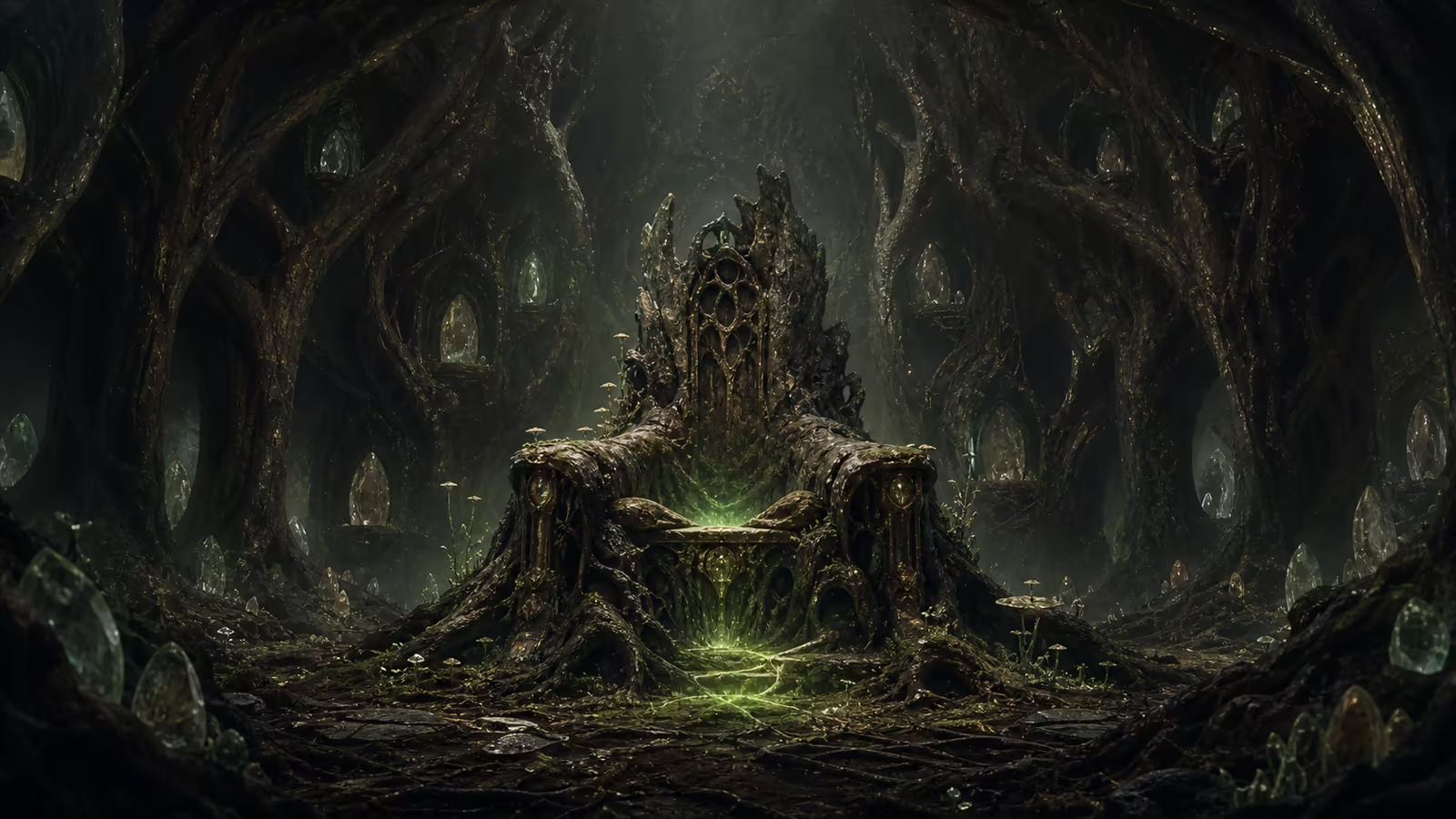
Growth, decay, ancient law.
Nature Throne
The Nature Throne listens to roots older than the celestial archive. Its citizens defend life without sentimental weakness.
Back Nature if the living world should judge the divine courts.
Origin of the Throne
The Nature Throne was not built nor forged, but grown from the corpse of the First Grove, a primordial forest that predated the theft of fate itself. In the age before the Book of Fate was stolen, when the heavens were still tethered to the earth by threads of prophecy, the First Grove was a living library of all that would ever be—a place where the roots of trees held the memory of every leaf that would fall, and the soil was rich with the bones of futures yet unborn. When the Book was taken, the First Grove shuddered, its roots tearing through the fabric of reality as it tried to hold onto the lost destinies it once nurtured. In that moment of cosmic agony, the eldest of the grove's spirits—the Verdant Wyrm, a serpent of woven bark and sap, and the Rotting Mother, a fungal entity of decay and rebirth—merged their essences into a single throne of intertwined wood, moss, and stone. This was the Nature Throne, a seat of living law that promised to enforce the cycles of growth and decay as the only remaining truths in a world where fate had become a lie. Its establishment was a desperate act of preservation, a declaration that even without the Book, the ancient rhythms of life and death would continue, guided by the throne's unyielding will. The first to claim the throne was the Verdant Wyrm itself, but it soon relinquished its rule to a mortal, the first Forester, a woman named Elara Thornwood, who had witnessed the grove's birth and understood that the throne required a human heart to temper its wild, amoral logic.
Doctrine
Citizens of the Nature Throne, known as the Rootbound, believe that the theft of fate was not a tragedy but a liberation—a chance for the universe to return to its primal state of organic chaos, where each life is a unique expression of the endless dance between growth and decay. They hold that the Book of Fate was a prison, a rigid script that denied the true nature of existence, which is to be ever-changing, unpredictable, and beautiful in its brutality. The core of their faith is the Cycle of the Eternal Return: all things must grow, all things must rot, and from rot, new life emerges. This is not a gentle philosophy; it demands that the weak be sacrificed so the strong may thrive, that the old be consumed so the new can rise, and that even the most cherished memories must eventually be composted into the soil of the future. Their temples are living groves where the walls are weeping bark and the floors are carpets of mycelium, and their priests, called the Thorn-Speakers, communicate with the throne through the sap of ancient trees and the spores of parasitic fungi. They practice a ritual known as the Grafting, where newborns are bonded with a seedling that will grow alongside them, and upon death, the bodies are returned to the earth to feed their tree-souls. The Rootbound are fiercely territorial, believing that the borders of their forest-kingdom are sacred boundaries where the throne's law of growth and decay must be enforced without mercy. They view other thrones as aberrations, especially those that seek to impose order or permanence, for in their eyes, only the Nature Throne understands the true, unspoken contract of existence: that life is a temporary loan from the soil, and the soil always collects its debt.
Current Conflict
After the Theft of Fate, the Nature Throne found itself in a unique position of power and peril. Without the Book to dictate the future, the throne's promise of growth and decay became the only stable law in a universe spiraling into uncertainty. The Rootbound seized this opportunity to expand their territories, sending out armies of walking trees and fungal swarms to reclaim lands that had been lost to the other thrones. They believe that by spreading their cycle across the cosmos, they can create a new, organic fate—a living network of cause and effect that will replace the dead script of the Book. However, this expansion has brought them into direct conflict with the Throne of Order, which seeks to impose static laws, and the Throne of Chaos, which revels in the very unpredictability the Nature Throne seeks to harness. The current conflict is a brutal, three-way war over the Verdant Spine, a mountain range that houses the Heartwood Nexus, a concentration of primordial energy where the First Grove once stood. The Order Throne has constructed a fortress of crystal and steel at the spine's peak, attempting to freeze the nexus into a permanent structure of law, while the Chaos Throne has unleashed a plague of sentient paradoxes that cause trees to grow upside-down and rivers to flow with acid. The Nature Throne's primary weapon in this conflict is the Blight Legion, an army of twisted, fungal-infused creatures that can decompose any matter into fertile soil, but this power comes at a cost: the Blight is slowly consuming the very forest it seeks to protect, turning the Rootbound's homeland into a festering bog of undigested memories. The throne's current ruler, the Forester Kaelen Mossheart, is a desperate man, torn between his duty to expand the cycle and his fear that the cycle itself is becoming a cancer. He has begun to whisper of a new doctrine, one that might embrace a form of stasis—a heresy that could shatter the Rootbound's faith and invite the other thrones to strike the final blow.
Notable Heirs
The Nature Throne does not select heirs through bloodlines or popular vote, but through the Verdant Judgment, a trial where candidates must survive a year within the Heartwood Nexus, absorbing its spores and roots into their own flesh. Those who succeed become Living Heirs, their bodies transformed into hybrid forms of wood, vine, and bone, each unique in its symbiosis with the throne. The most famous Living Heir is Lira of the Thousand Roots, a woman whose legs have become a network of subterranean tendrils that allow her to sense the emotions of the soil itself. She is a quiet, melancholic figure, often found communing with the dead trees of the Blight Legion, trying to understand why the cycle has turned so violent. Another type of heir is the Spore-Born, individuals who are not chosen but born from the fungal masses of the throne's underside, emerging fully formed with memories of the forest's collective consciousness. These heirs are rare and often unstable, their personalities shifting with the seasons, but they possess an innate understanding of decay that makes them invaluable as strategists. The most infamous Spore-Born is the one known only as the Rotting Prince, a being of perpetual decomposition whose touch can turn stone to mush. He is a paradox, a creature of absolute entropy who nonetheless serves the throne's will, and his loyalty is a constant source of suspicion among the other heirs. Among the most famous witnesses to the throne's power is the Eternal Gardener, a mythical figure said to be the first human to ever sit on the Nature Throne, Elara Thornwood, who now exists as a ghostly tree whose branches hold the souls of all who have died in service to the cycle. She is not a ruler but a memory, a living testament to the throne's ancient law, and her whispers are sought by those who wish to understand the throne's true intentions. Another witness is the Withering Sage, a mortal scholar who spent a century studying the throne's fungal networks and emerged with a mind shattered into a thousand different timelines, each one a possible future for the forest. He now roams the Rootbound lands, speaking in riddles that often predict the throne's next move, but his sanity is a fragile thing, and many fear he will one day become a vector for the Chaos Throne's influence.
Why back this Throne
In-world fiction: powers, items, titles, and consequences in this section are narrative devices, not real-world products or promised benefits.
Back Nature if you want growth, decay, and ecological conflict to receive more attention. Grafting, Rootbound titles, and living artifacts are in-world fiction, not active digital products.
What does this Throne represent?
Growth, decay, ancient law.
How do readers support it?
Readers can explore this Throne and use the public vote as a non-binding editorial signal. A pending Registry request is optional and is not a verified identity.
Does voting decide the whole story?
No. Voting is one signal. The canon remains curated so the world stays coherent while still responding to its citizens.
Genesis Registry
Back the Nature Throne.
Explore the archive and use the public vote as a non-binding signal. Registry requests remain pending until email verification launches.