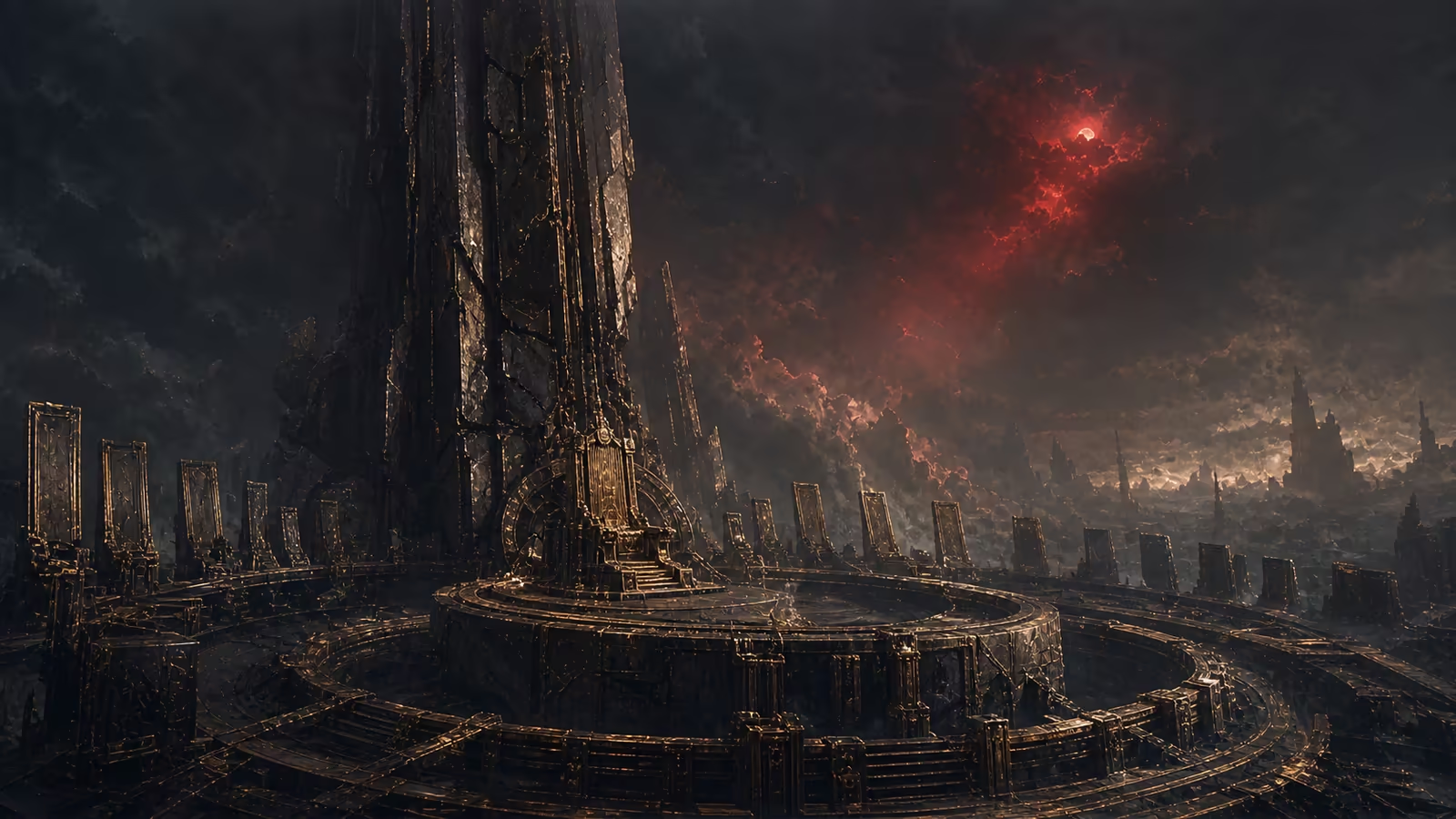
Conflict, discipline, irreversible choice.
War Throne
The War Throne understands that history often moves when compromise runs out. Its citizens study every wound as strategy.
Back War if the First Age must be decided, not debated.
Origin of the Throne
The War Throne was not forged in council chambers or consecrated by trembling priests. It was born from the first scream of a broken world. When the cosmic entity known as the Axiom of Order shattered the primordial silence, it demanded that all things bow to a singular, immutable law. But in the deep folds of the nascent universe, where chaos still wept and bled, there existed a shard of pure, unyielding opposition—a splinter of the dying god Khaos-Met, who had refused to be tamed. This shard, a jagged obsidian monolith called the Sorrow-Spike, was discovered by the first mortal to defy the Axiom: a warlord named Vaelen the Unbound. He was a man of scarred flesh and unbending will, who had watched his entire tribe be erased by the Axiom’s Edict of Silence for daring to whisper a prayer to a forgotten star. Vaelen did not bow. He took the Sorrow-Spike, plunged it into the heart of a dying sun, and from that fusion of rebellion and stellar fire, the War Throne was hammered into existence. Its first seat was not a throne room, but a battlefield of frozen time, where Vaelen sat upon the cooling metal and declared, ‘Let all who would be unmade by fate instead unmake it first.’ The War Throne’s foundation is thus a monument to refusal—a refusal to accept predestination, a refusal to kneel, and a refusal to die quietly. Its very presence in the cosmos is a scar, a beautiful and terrible wound that pulses with the rhythm of every war ever fought and every war yet to come. The Throne does not rest on a single planet; it exists as a fissure in reality, a perpetually shifting battlefield known as the Crucible of Scars, where the landscape is made of shattered armor and the rivers run with molten ichor from fallen gods. To approach it is to feel the weight of every conflict that has ever been, and to know that your own blood will soon add to the tally.
Doctrine
Citizens of the War Throne, known as the Unbroken, hold a single, brutal creed: ‘The Path is the Price.’ They do not worship peace, prosperity, or even victory. They worship the act of struggle itself. They believe that the soul is a blade that must be sharpened on the whetstone of suffering, and that the only sin is stagnation. To the Unbroken, the theft of the Book of Fate was not a catastrophe—it was a liberation. They preach that fate was a cage, a lie told by the weak to justify their cowardice. Now that the book is gone, every choice is a true choice, every battle a genuine test of will. They do not mourn the lost future; they celebrate the chaos of the present. Their temples are arenas, their prayers are war cries, and their holy texts are the scars they bear. The Unbroken believe that discipline is the only shield against the void. They train relentlessly, not to become perfect soldiers, but to become perfect instruments of their own will. They practice a form of meditation called ‘The Iron Breath,’ where they hold their lungs full of superheated air until they nearly pass out, learning to master pain. They believe that a mind that cannot control its own body is a mind unworthy of choice. Their society is a meritocracy of the relentless: the highest rank, the ‘Warden of the Unforged,’ is given to the warrior who has survived the most battles without ever retreating. But this doctrine has a dark edge. The Unbroken are prone to nihilistic violence, viewing diplomacy as a form of cowardice and mercy as a weakness that spreads like a disease. They will burn a planet to test the resolve of its people, believing that only those who survive the fire deserve to have their choices matter. Their greatest hero is not a conqueror, but a woman named Seraphine the Unscarred, who won a thousand duels without ever drawing blood, proving that discipline can be a weapon of absolute control. Yet even she was eventually consumed by the doctrine, her final act being to throw herself into a dying star to prove that even the most perfect discipline must eventually embrace the end.
Current Conflict
After the Theft of Fate, the War Throne has become a vortex of violent opportunism. The other Thrones scramble to rewrite reality, to impose new laws, or to hide in the shadows. The War Throne does none of this. Its current Warden, a being known as Kaelen the Sunderer, has declared a ‘Great Reaping.’ He believes that with fate gone, the universe is a raw, chaotic ore, and only through endless conflict can the true metal of existence be purified. The War Throne has launched a massive, unending assault on the ‘Anchor Points’—the few remaining stable realities where the other Thrones have established their domains. They do not seek to conquer these places; they seek to break them, to shatter the illusion of safety, and to force every being in the cosmos to choose a side in the eternal battle. Their current campaign is against the ‘Garden of Silent Whispers,’ a domain of the Throne of Knowledge. The Garden is a library-planet where every book contains a living memory. The Unbroken are not burning the books; they are fighting within the books themselves, turning every story into a battlefield. A single page from a romance novel has become a war zone where two armies of spectral warriors clash over a single line of poetry. The conflict is bleeding into reality, causing ‘Narrative Quakes’ where the laws of physics rewrite themselves based on the outcome of a fictional duel. Kaelen himself is locked in a perpetual duel with the Guardian of the Garden, a creature made of ink and forgotten alphabets. Their battle has lasted for three subjective centuries, and neither has landed a decisive blow. The War Throne is also facing an internal crisis. A faction called the ‘Broken Oaths’ has emerged, led by a former Warden named Thera the Weary. She argues that the endless conflict is itself a form of fate, a prison of constant reaction. She claims that true choice requires the possibility of peace, and that the War Throne has become just as tyrannical as the Axiom of Order it was built to defy. This schism has led to civil war within the Crucible of Scars, with the Broken Oaths battling the Unbroken in the very heart of their own domain. The War Throne is now a paradox: a weapon that is also a wound, a force for absolute freedom that is now fighting itself for the right to define what freedom means.
Notable Heirs
The War Throne attracts a specific breed of heir: those who have been broken by the world and have chosen to break back. The first type is the ‘Shattered Blade’—a warrior who has lost everything: family, home, purpose. They come to the War Throne not for vengeance, but for annihilation. They seek to become so sharp, so focused, that they can cut through the very concept of loss. A famous Shattered Blade is Lysander the Ash-Born, whose entire city was turned to glass by a stray spell from a forgotten war. He now fights with a sword made from the fused bones of his own children, and his every victory is a silent scream. The second type is the ‘Iron Dreamer’—a philosopher-warrior who believes that the only way to understand reality is to test it to destruction. They are often scholars of pain, who study the geometry of wounds and the physics of impact. The most notorious Iron Dreamer is Architect Vex, a being who has no face, only a helmet that projects a constantly shifting pattern of mathematical equations. He constructs ‘War-Scapes’—entire pocket dimensions designed to be perfect killing fields, which he then sells to the highest bidder. He does not care who wins, only that the battle is elegant. The third, and rarest, type is the ‘Witness of the Unforged’—a being who has seen the War Throne’s origin and survived. These are not warriors in the traditional sense; they are living records of the Throne’s history. The most famous Witness is an ancient entity called the Echo of Vaelen, a spectral remnant of the first Warden that exists as a loop of sound. It repeats the same phrase over and over: ‘I chose. I chose. I chose.’ It is said that if you can understand the exact meaning of that phrase, you will gain the power to rewrite your own past. No one has ever succeeded. The Witnesses are revered but feared, as they are often driven mad by the weight of the Throne’s memory. They are kept in a special zone of the Crucible called the ‘Fossilized Silence,’ where they are frozen in time, their eyes forever open, watching the endless battles.
Why back this Throne
In-world fiction: powers, items, titles, and consequences in this section are narrative devices, not real-world products or promised benefits.
Back War if you want the archive to confront strategy, sacrifice, and the human cost of conflict. It is a story preference, never an endorsement of real violence or a promised personal transformation.
What does this Throne represent?
Conflict, discipline, irreversible choice.
How do readers support it?
Readers can explore this Throne and use the public vote as a non-binding editorial signal. A pending Registry request is optional and is not a verified identity.
Does voting decide the whole story?
No. Voting is one signal. The canon remains curated so the world stays coherent while still responding to its citizens.
Genesis Registry
Back the War Throne.
Explore the archive and use the public vote as a non-binding signal. Registry requests remain pending until email verification launches.